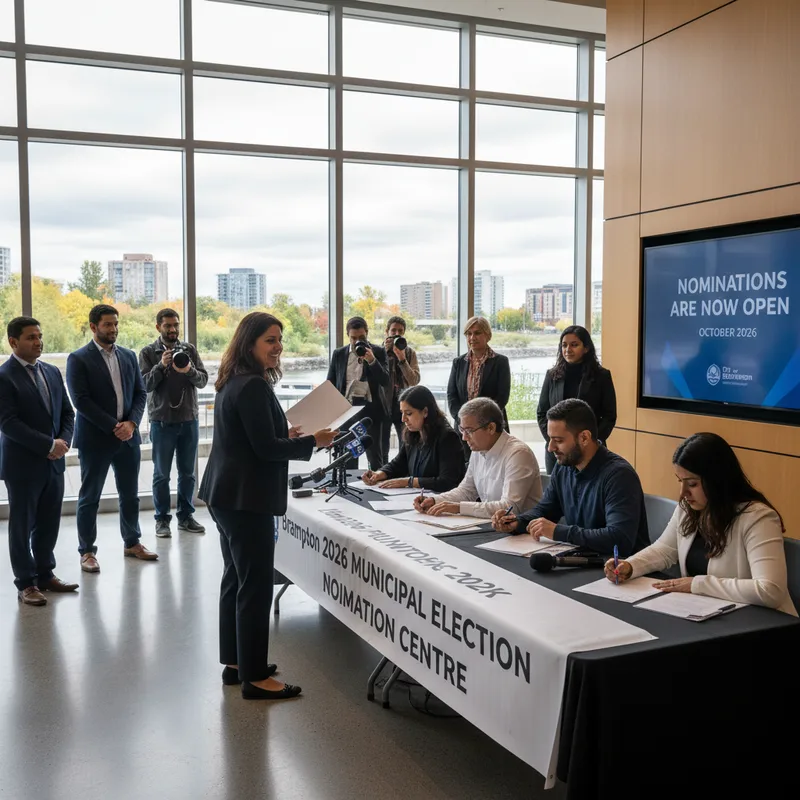
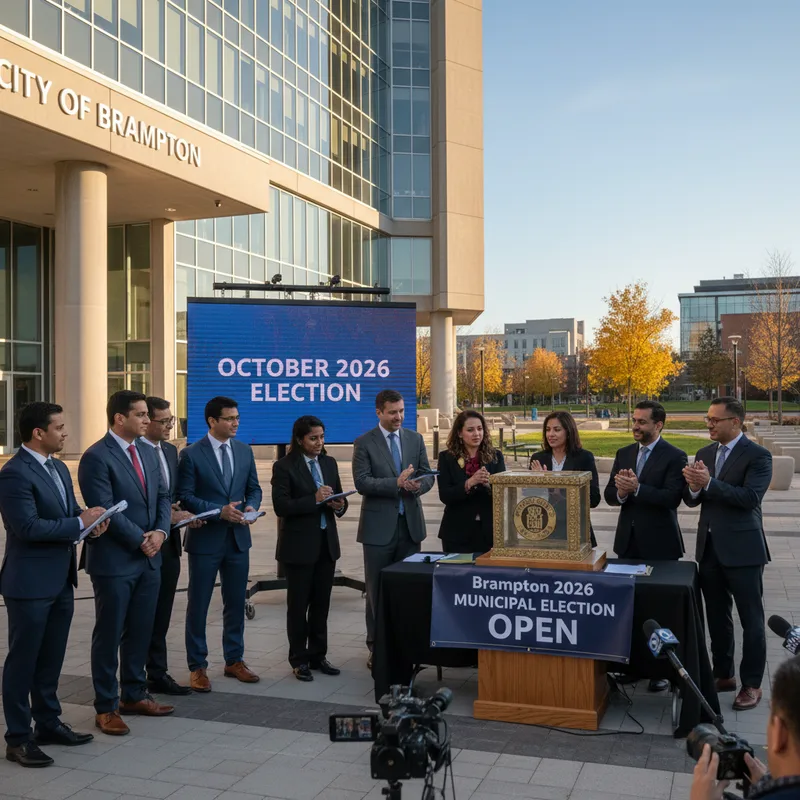
The unofficial starting pistol for Brampton's next municipal election has been fired. The City Clerk's office announced it will begin accepting candidate nominations on Friday, May 1, for residents who intend to run for public office in the upcoming 2026 election.
Prospective candidates for mayor, city councillor, regional councillor, and school board trustee can now begin the formal process of putting their names on the ballot. This marks the beginning of a nearly six-month period of political activity that will culminate with voters heading to the polls on Monday, October 26, 2026.
The nomination window will remain open throughout the summer, giving hopefuls time to organize their campaigns and gather support. However, a firm deadline has been set for Friday, August 21, 2026, at 2 p.m., after which no further nominations will be accepted.
The roles of municipal leadership
The election will determine the makeup of Brampton's government for the next four years, with leaders elected to make decisions on a wide range of local issues. The positions of city councillor and regional councillor, while similar, hold distinct responsibilities that directly impact residents.
City councillors focus primarily on Brampton-specific matters, overseeing services like local road maintenance, public transit, recreation programs, and city parks. They vote on the municipal budget and create local bylaws. Regional councillors, in contrast, wear two hats. They sit on Brampton City Council but also represent the city at Peel Regional Council. This larger body manages services that span across Brampton, Mississauga, and Caledon, including public health, paramedic services, regional roads, and waste collection.
The mayor serves as the head of council, providing leadership and representing Brampton at both the municipal and regional levels. The mayor's role often involves advocating for the city's interests with provincial and federal governments to secure funding for major projects, such as the recent federal contribution to a new recreation hub. While municipal leaders focus on local concerns, they operate within a larger governmental framework. Federal bodies handle national issues such as defence and international policy, a separate jurisdiction that was highlighted when it was announced that Canada will host a new NATO defence bank, as detailed in the article Canada to host new NATO defence bank.
The path to candidacy
Becoming a candidate involves more than just a desire to serve. The City of Brampton has laid out a clear, multi-step process governed by provincial law. Nomination forms are available online or at the City Clerk’s Office, but they must be filed in person by appointment. The only exception is the final day for nominations, August 21, when candidates will be served on a first-come, first-served basis from 9 a.m. to 2 p.m.
Candidates must also pay a filing fee, set at $200 for mayora aspirants and $100 for all other offices. This fee, payable by methods ranging from cash to credit, serves as a filter to ensure a degree of seriousness among contenders. Furthermore, applicants must provide original identification that proves their name and qualifying Brampton address. Photocopies or digital versions will not be accepted, a strict rule to ensure all candidates meet the legal eligibility requirements of being a Canadian citizen, at least 18 years old, and a resident or property owner in the municipality.
Crucially, the Ontario Municipal Elections Act dictates that a candidate cannot raise or spend any money on their campaign until their nomination papers have been officially filed with the clerk. This ensures a level playing field and official oversight from the moment a campaign financially begins.
Our schools' elected officials
Often overlooked in the heat of mayoral and council races are the school board trustee positions. These elected officials play a critical role in shaping local education, overseeing the budgets and policies of the publicly funded school systems that serve the city's youth. Brampton voters will elect trustees for three different boards: the Peel District School Board, the Dufferin-Peel Catholic District School Board, and the French-language Conseil scolaire catholique MonAvenir.
A fourth board, the French-language public board Conseil scolaire Viamonde, also serves Brampton students. However, nominations for this position are being handled by the City of Mississauga, as the board’s administrative boundaries cross multiple municipalities.
The influence of third-party advertisers
The election is not just for candidates. Any individual, corporation, or trade union that wishes to spend money to promote, support, or oppose a candidate must register as a third-party advertiser. This rule is designed to ensure transparency in who is attempting to influence the election's outcome.
These groups must also register in person at the City Clerk's Office and are bound by similar rules as candidates, including a prohibition on spending money before their registration is complete. The registration period for third-party advertisers extends longer than the candidate nomination period, closing on Friday, October 23, 2026, just three days before the election.
Potential issues on the 2026 campaign trail
As candidates begin to file their papers, the key issues that will define the 2026 campaign will start to take shape. Public safety remains a top priority for many residents, a sentiment previously highlighted during public safety forums in the city. Other likely topics of debate include housing affordability, traffic congestion, and the future of local and regional governance, especially as Brampton prepares to take ownership of the Peel Art Gallery, Museum and Archives.
With a population of 800,000 and more than 400,000 eligible electors, the campaign will be a hard-fought contest to win the hearts and minds of a diverse and rapidly growing city. The city will maintain a running list of nominated candidates on its Brampton Votes website, which will be updated as filings are certified.
For now, all eyes are on the City Clerk’s office as the first wave of prospective leaders step forward to officially enter the race, a process that will continue until the final deadline on August 21. The results of their efforts will be decided by voters on October 26, 2026.