
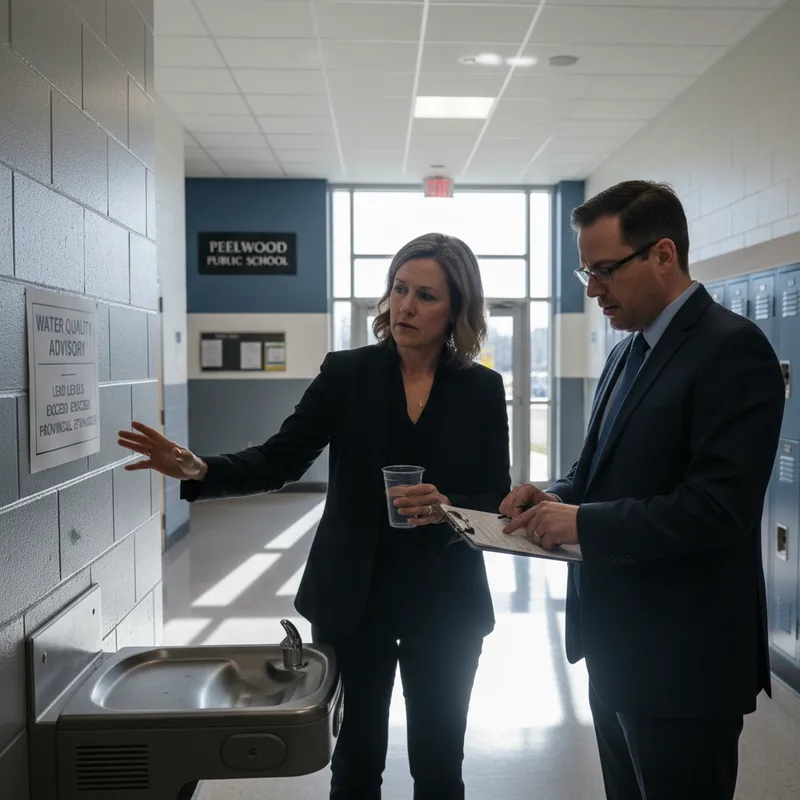
Two Peel school boards landed near the top of Ontario’s rankings for elevated lead in school drinking water.
A Canadian Environmental Law Association report released March 16 puts Dufferin-Peel Catholic second and Peel District fourth for exceedances in the 2024-25 school year.
Which peel school boards ranked highest for lead in school water
The report ranks boards by the number of tests above Ontario’s 10 parts per billion limit for lead. Ottawa-Carleton District School Board ranked first with 104 exceedances.
Dufferin-Peel Catholic District School Board recorded 40 exceedances. Toronto District School Board had 30, and Peel District School Board had 23, the report says.
The analysis used provincial testing data and compared boards across Ontario. The report is titled “F for Effort: Ontario is falling behind on getting lead out of school drinking water.”
Which mississauga and brampton schools appeared in the top 10
Two Dufferin-Peel Catholic schools appeared in the report’s top-10 list for individual schools. St. Francis of Assisi Catholic Elementary School in Mississauga ranked sixth with seven exceedances.
St. Kevin Catholic Elementary School in Brampton ranked 10th with five exceedances.
The report says the full school-by-school list appears in its downloadable appendix.
What ontario’s lead limit means, and why critics want 5 ppb
Ontario requires action when results exceed 10 ppb. The report notes that Health Canada set a stronger guideline of 5 ppb, which most provinces and territories use.
“Only 17 schools in PDSB exceeded 10 ppb, but 30 exceeded the 5-ppb standard. In the DPCDSB, 18 schools exceeded 10 ppb, but 32 exceeded 5 ppb,” Julie Mutis said in an email.
Mutis argues the difference matters for exposure prevention. “In the rest of the country, water testing results from the schools that exceeded 5 ppb, but not 10 ppb, would spark action on mitigating lead exposure,” she said.
She said Ontario’s rules treat those results as acceptable. “In Ontario, those results are considered ‘safe’ and can even be used to justify exemptions from annual testing in the future,” Mutis said.
Health Canada’s current guidance for lead in drinking water is posted in its technical documents for the guideline. Parents can also read the federal background through Health Canada’s lead guideline technical document.
How much testing happens at each school fixture
Mutis said testing volume can shape what boards find. She pointed to Peel District’s testing approach in most schools.
“If we aren’t looking for lead, we won’t find it,” said Mutis. She added that because “Ontario’s lead in schools regulation is so outdated, compliance with the requirements does not always mean safety.”
Mutis said Peel District tested only one water fixture at the vast majority of its schools, despite its history of ranking high for lead exceedances.
By contrast, Mutis said Dufferin-Peel Catholic appears to test multiple water fixtures in most schools. She said other boards should follow that practice.
What peel district and dufferin-peel catholic say they do next
Peel District spokesperson Malon Edwards said the board meets provincial requirements and maintains processes for ongoing compliance. “The health and safety of our school communities is always a top priority, which is why we are thorough and diligent in our testing of lead in water sources,” he said in an email.
Edwards said annual testing covers water for drinking and cooking, with samples analyzed under provincial rules and reviewed by Peel Public Health. “If flushed lead levels exceed provincial standards, the fixture is taken out of service immediately, and corrective actions are taken to resolve the issue,” he said.
Dufferin-Peel Catholic spokesperson Nancy Marshall said the board continues to meet Ontario Regulation 169/03 requirements. “We work closely with our public health partners and the Ministry of the Environment to ensure full compliance, coupled with following all recommendations set forward to maintain the highest standards of safety for our school communities,” she said in an email.
Marshall said the board tests all drinking water annually and uses both standing and flushed samples from the same fixtures. “All drinking water in DPCDSB schools is tested annually (as per Ontario Regulation 169/03) by a board-accredited consultant using samples of both standing and flushed water from the same fixtures,” she said.
She said an independent lab tests the samples, and Peel Public Health receives the results. “Clearance must be received from Peel Public Health in order for drinking water using fixtures in a school to be used,” Marshall said.
Families tracking other local education issues can also read Brampton-focused coverage at Brampton Befluent.
For a look at how other communities plan kid-friendly programming during school breaks, see free March break fun in Waterloo Region and Guelph.
CELA’s report calls for Ontario to align its action threshold with the 5 ppb standard used in most of Canada, and to modernize testing and mitigation expectations for school water systems.