

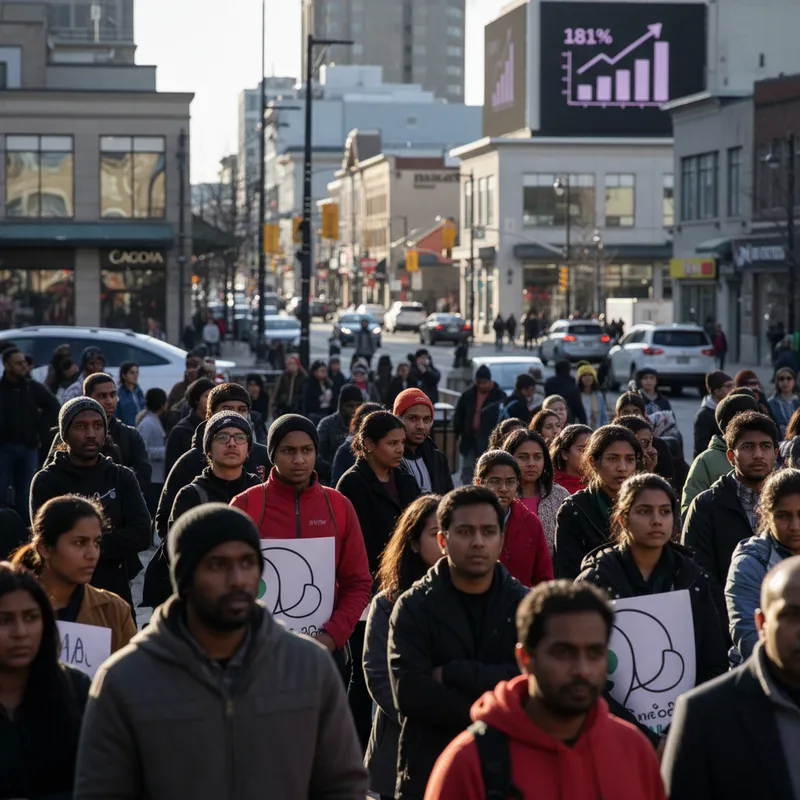
Hate crimes reported in Brampton and Mississauga have surged by 181 per cent since 2016, according to the latest data from Peel Regional Police (PRP). The statistics show a disturbing trend of increasing hate-motivated incidents in one of Canada’s most diverse regions.
In 2024, police verified 166 hate-motivated incidents, a significant rise from the 59 confirmed cases in 2016. Data for 2025 is currently under review and is expected to be released by the PRP upon the completion of its internal verification process. The statistics reveal a concerning pattern, with the number of reported incidents growing steadily in recent years.
The provided data shows a fluctuating but ultimately upward trajectory. After an initial spike to 158 incidents in 2017, the numbers declined to a low of 93 confirmed cases in 2020. However, from 2020 to 2024, there has been a consistent year-over-year increase, causing alarm for residents and community leaders.
A worrying trend in a growing city
This rise in hate-motivated crime comes as Brampton experiences unprecedented population growth. The city's population expanded by nearly 90,000 people in a single year between 2021 and 2022 and is on a trajectory to reach one million residents sooner than official projections anticipated. This rapid diversification, with residents from 250 different cultures speaking 171 languages, makes the increase in hate-motivated incidents particularly troubling.
Brampton’s identity is deeply intertwined with its multicultural fabric, a celebrated aspect of the community that is now being threatened by a rise in prejudice. The city is home to a thriving South Asian music scene and recently saw the launch of a new health hub aimed at providing culturally sensitive care for Black communities. These community-led initiatives highlight the vibrant diversity that is increasingly being targeted. The trend in Peel Region mirrors a national problem. According to Statistics Canada, police-reported hate crimes in Canada increased by 7 per cent in 2022, following a significant 27 per cent rise in 2021. The national data shows that incidents motivated by hatred toward a race or ethnicity remain the most common type of hate crime, similar to issues seen recently in communities elsewhere, where police arrested a 12-year-old in a fatal school bullying case.
What constitutes a hate crime?
Peel Regional Police define hate-motivated crimes as any Criminal Code offence where hatred, bias, or prejudice based on characteristics like race, ethnicity, religion, sexual orientation, disability, or gender identity is a motivating factor, either "in whole or in part."
These crimes are not limited to violent acts. Incidents can range from threats and harassment to property damage (mischief) and assault. However, police also clarify that disrespectful, discriminatory, or hostile speech on its own does not meet the threshold of a hate crime under the Criminal Code of Canada. For speech to be considered a criminal offence, it must cross a specific legal boundary into wilful promotion of hatred.
Black and South Asian communities most targeted
The 2024 data provided a distressing breakdown of the communities most affected. Of the 166 incidents, 98 were motivated by race or ethnicity, 62 by religion, 22 by sexual orientation, and two by gender. A single incident can be classified with more than one motivating factor.
Among those targeted for their race or ethnicity, Black community members were the most frequent victims, with 42 reported incidents. South Asian residents were targeted 39 times, followed by Arab people (10 times), Asian people (5 times), and Caucasian people (twice). The significant number of incidents targeting Black and South Asian residents is particularly concerning given these communities form a large part of Brampton’s demographic makeup.
While Peel police did not provide a specific breakdown for groups targeted based on religion, the 62 incidents motivated by religious bias represent a substantial portion of the total. These statistics underscore the vulnerabilities faced by various minority groups across the region.
Police and city officials respond
In response to the escalating numbers, Peel Regional Police have established a new centralized Hate Crime Unit. In a statement, the service said it will "focus on identifying, investigating, and addressing hate motivated crime while working closely with community partners to support those affected."
Brampton Mayor Patrick Brown, who is also a member of Peel Region council, expressed his deep concern over the statistics, condemning the nature of these offences.
It’s insidious. It’s ugly. It has no place in Canada, and it has no place in Peel Region. And I hope that anyone who commits a hate crime is prosecuted. I would also say, those that have hate in their hearts do not represent the majority. I believe 99 per cent of the community is loving, decent and kind. And we can’t allow a few bad apples to define us.
The mayor’s comments reflect a commitment from local leadership to combat hatred and reinforce a message of unity. The new police unit and public condemnation from officials signal a more focused effort to tackle the problem head-on.
As Peel Region continues to grow and diversify, the challenge will be to ensure that its social fabric strengthens rather than frays. The work of the new Hate Crime Unit and the support of community partners will be critical in addressing the root causes of prejudice and protecting all residents. The police service encourages anyone who has experienced or witnessed a hate-motivated crime to report it.