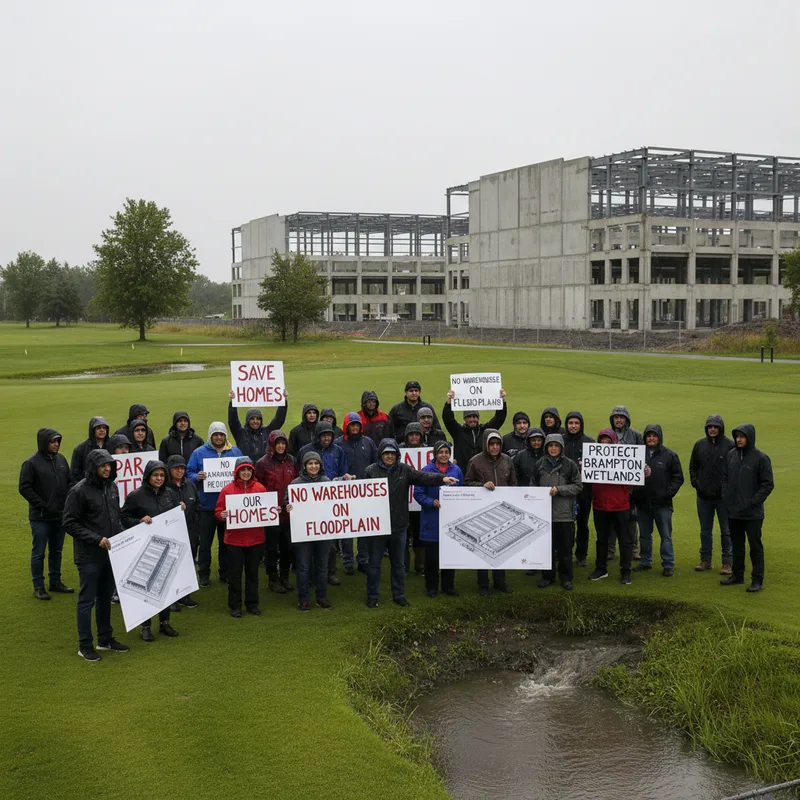
A proposal to pave over the Streetsville Glen Golf Club for a massive industrial complex has ignited fierce opposition from Churchville residents, who are raising alarms about potentially catastrophic flooding, environmental destruction, and the erosion of their community's character. Kaneff Properties has applied to rezone an approximately 17-hectare parcel of land to build four large industrial buildings and sprawling parking lots, but people living in the historic, low-lying neighbourhood say the area cannot handle any more development.
The land, located at 1876 and 1990 Hallstone Road, is situated directly within the Credit Valley Conservation Authority's (CVC) regulated floodplain of the Credit River. Residents argue that adding more concrete and asphalt to this sensitive area will inevitably worsen the frequent and dangerous floods that have plagued the community for a century.
The developer's application seeks to replace the existing golf course and a gas station with what it terms "prestige industrial" buildings, which could include warehouses, data storage centres, or medical laboratories. This vision has been met with a wall of organized resistance from neighbours who fear for their homes and the local environment.
A community on high alert over flood risk
The fear of flooding in Churchville is not theoretical, it is a deeply felt part of the community’s history. The City of Brampton itself acknowledges the neighbourhood has a "long history of flooding," documenting at least 34 separate flood events between 1922 and 2022. The most recent major disaster occurred in February 2022, when heavy rain and melting snow caused a massive ice jam on the Credit River, forcing the evacuation of at least 50 homes and damaging 22 properties.
Residents Nancy and Maxim Mendes expressed these fears in a formal letter to Brampton council, noting that recent commercial developments have already had a visible impact. "Over the past few years. residents have already observed noticeable changes in the nearby stormwater pond, including expansion and rising water levels closer to residential properties," they wrote. They called the addition of more impervious surfaces in the floodplain a "serious concern," warning that it will "exacerbate an already evolving drainage issue and put surrounding homes at risk."
To address these concerns, a flood assessment commissioned by Kaneff proposes the use of underground stormwater tanks and separators to manage runoff before it is discharged into Levi Creek. The study concludes this system would be sufficient to prevent any increase in flood risk. However, residents who have witnessed the creek overflowing its banks firsthand are not convinced by these technical assurances.
We are not merely ‘data points’ in a study; we are the families who live here. We ask the City to mandate enhanced protection measures that go above and beyond the minimum legal requirements.
In his own letter to the city, local resident Kamran Qayyum implored decision-makers to look beyond the developer's reports. "As of today, March 17, 2026, the creek behind our properties is currently in a state of overflow due to recent [rain/melt]. This is happening before any industrial ‘hardscaping’ has been added to the area," Qayyum wrote, inviting councillors to visit and see the situation for themselves. "We believe decision-makers must see the reality of this flood plain in person before relying solely on the theoretical 'satisfactory' ratings provided in the proponent's reports."
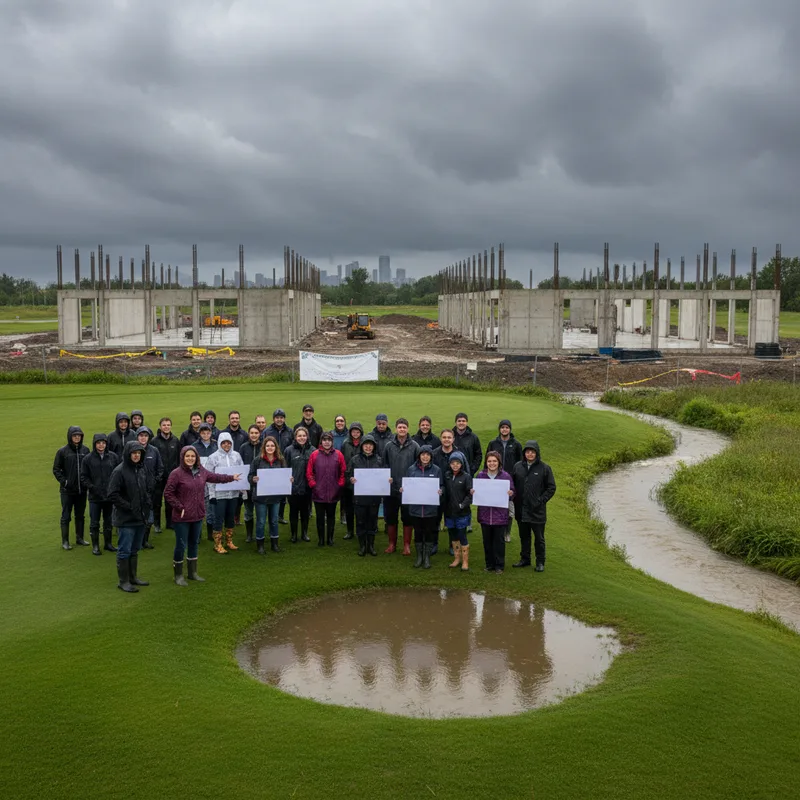
'Severe' disruption to natural corridor and wildlife
Beyond the immediate threat of flooding, the proposed development would decimate a significant local green space and natural habitat. An Environmental Impact Statement (EIS) submitted by the developer details a plan that involves cutting down 189 of the 203 trees currently on the property. This large-scale removal would destroy habitat for a wide array of local and migratory wildlife.
The property contains a provincially significant wetland and serves as a critical habitat for the endangered redside dace, a small fish species. While the dace has not been documented in this specific part of Levi Creek since 1954 and is "presumed" to be locally extinct, its historical presence underscores the area's ecological importance. The proposal could require a permit from the Department of Fisheries and Oceans due to its impact on the creek. Furthermore, ecological studies identified 46 different bird species in the area, including the barn swallow, which is recognized as a species at risk.
In his letter, resident Michael Nashat warned of the broader impacts of such a large industrial neighbour. "The light pollution, continuous noise, and potential stormwater runoff from these facilities will degrade the habitat for the wildlife that relies on the Levi Creek corridor, pushing displaced animals into our residential streets," Nashat stated. The loss of green space stands in stark contrast to the city's promotion of its natural heritage, including its many parks and hiking trails.
Despite the clear environmental disruption, Kaneff's report claims the plan will provide a “net benefit” to the local ecosystem. The report argues that because the land is currently a “highly disturbed” golf course, their plan, which includes conveying valley lands to the city, represents an improvement. This claim has been called misleading, as it equates the green, permeable space of a golf course with a paved-over industrial site. This type of argument has been criticized in other regional development battles, including a major warehouse proposal in Caledon where experts challenged similar claims of an 'ecological benefit' for building in the Greenbelt.
Proposal clashes with Brampton's official plan
The developer's vision for the site is also at odds with the city's established planning framework. According to a staff presentation at a recent Planning and Development committee meeting, the project cannot proceed without significant amendments to Brampton's Official Plan, the local Secondary Plan, and the city-wide 'Brampton Plan' that was just approved in 2023. This is because existing policies do not permit the heavy 'prestige industrial' uses Kaneff is proposing.
Residents have seized on this conflict, arguing the development is fundamentally unsuited for the area. "This specific location serves as an entrance to our residential area, and dropping a massive industrial complex here is entirely incompatible with the surrounding family-focused neighborhood," wrote Michael Nashat. "A development of this scale and nature belongs in a dedicated industrial park, not pushed right up against a family community and a sensitive environmental corridor." The issue reflects broader planning challenges across Ontario, as cities like Windsor chart out future development on sensitive lands.
The community is calling on Brampton City Council to reject the requested amendments and uphold the current plans that protect their neighbourhood from such intensive development. Concern is further heightened by the fact that the proposed zoning bylaw includes no restrictions on building heights, leaving the door open for towering structures to loom over the adjacent residential streets and natural corridor.
As the application moves through the city's planning process, officials will have to weigh the developer's promises against the documented history of flooding and the passionate pleas from a community determined to protect its safety and environment. For residents, the fight is about ensuring their neighbourhood is not sacrificed for a development they believe is in the wrong place at the wrong time.
Kamran Qayyum's letter sums up the community's demand for accountability. "We request ongoing post-development monitoring (flooding, noise, traffic) with publicly accessible reporting and a clear process for residents to resolve issues," he concluded.